How to Sign a Legal Document: A Complete Guide

Fast navigation
- Key Takeaways//
- What Makes a Legal Document Valid and Binding?//
- What Does Signing a Legal Document Actually Mean?//
- What Are the Acceptable Signatures on Legal Documents?//
- How to Sign a Legal Document: 8 Essential Steps//
- Do You Need a Witness or Notary Public?//
- Can You Sign Legal Documents Electronically?//
- Common Questions About Signing Legal Documents//
- Mistakes to Avoid When Signing Legal Documents//
- When a Signed Legal Document May Not Be Valid//
- Final Thoughts
Your signature on a legal document is more than just your name on paper. It represents your agreement to be bound by the terms within that document, whether it's a lease, employment contract, business agreement, or will.
Many people treat signing as a quick formality, but small errors like using the wrong ink, forgetting to date the document, or having an unqualified witness can create serious problems later.
This guide explains how to sign legal documents correctly and avoid common mistakes.
Key Takeaways
Before you sign any legal document, keep these essential points in mind:
- Your signature shows that you agree to the terms and intend to be legally bound
- Courts usually assume you have read and understood the document once you sign it
- Always review the full document, including fine print, before signing
- Make sure you are signing the final and correct version
- Sign in the correct capacity (individual or on behalf of a business)
- Use proper formatting, including blue or black ink for paper documents
- Ensure all required parties sign the document
- Some documents require witnesses or notarization to be valid
- Electronic signatures are legally valid in most cases if certain conditions are met
- Always keep a signed copy for your records
What Makes a Legal Document Valid and Binding?
Key Elements of a Legally Binding Document
Before signing any legal document, you should understand what makes it enforceable. Five essential elements determine whether a document is legally binding.
Offer and Acceptance — One party makes a clear offer, and another accepts it. For instance, when a freelance designer proposes to create a logo for $500 and the client agrees, both parties have entered into an agreement.
Consideration — Each party must exchange something of value. This could be money, services, goods, or a promise. If you hire a photographer for your wedding and agree to pay $2,000, your consideration is the payment, and the photographer's consideration is their service.
Mutual Intent — All parties must genuinely intend to be legally bound. If your neighbor casually says they will help you paint your house for dinner, a court likely would not consider this an enforceable contract because there was no serious intent.
Legality — The document's purpose must be lawful. An agreement to split profits from selling counterfeit products would never be enforceable, regardless of how formally it is written or signed.
Capacity — Every signer must have legal ability to enter the agreement. This means being of legal age, mentally competent, and not impaired by drugs or alcohol. For example, a contract signed by a 16-year-old to purchase a car may be voided because minors generally lack contractual capacity.
Types of Legal Documents That Require Signatures
Many documents require signatures for validity. Common examples are: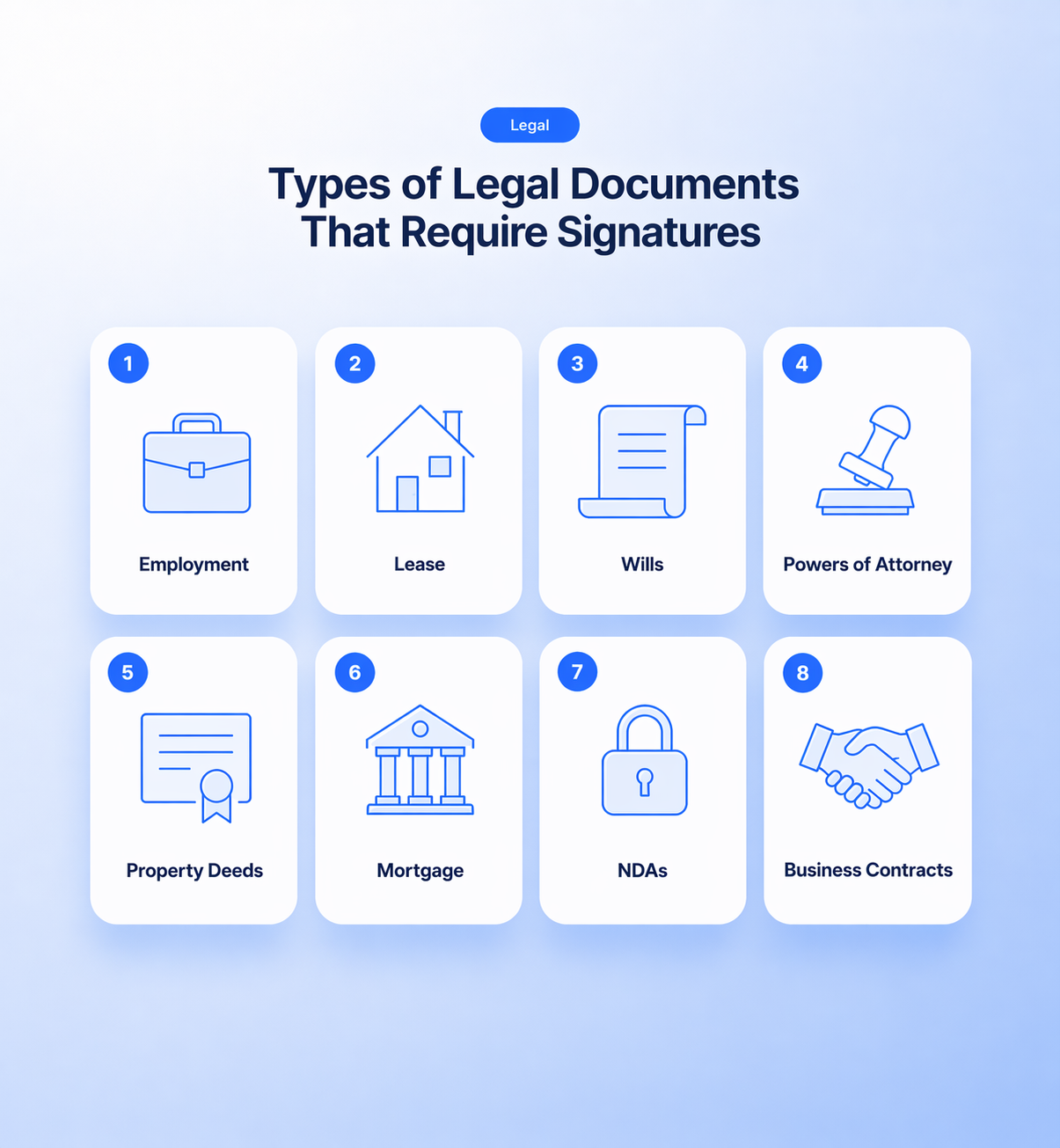
- Employment contracts- Agreements between an employer and employee that define job roles, responsibilities, salary, and terms of employment.
- Lease agreements- Documents that outline the terms between a property owner and tenant, including rent, duration, and usage conditions.
- Wills- Legal documents that specify how a person’s assets and responsibilities should be handled after their death.
- Powers of attorney- Authorize someone to act on another person’s behalf in legal, financial, or medical matters.
- Property deeds- Official records that prove ownership of a property and detail the transfer of ownership.
- Mortgage documents- Agreements between a borrower and lender that define loan terms for purchasing property.
- Non-disclosure agreements- Contracts that protect sensitive information by preventing parties from sharing it with others.
- Business contracts- Legally binding agreements between businesses or individuals outlining roles, responsibilities, and terms of a deal.
Certain documents like wills and real estate deeds often require additional formalities such as witnesses or notarization.
What Does Signing a Legal Document Actually Mean?
When you sign a legal document, you are doing more than just writing your name. You are confirming that you understand the terms and agree to be legally bound by them.
In most cases, courts assume that once you sign, you have read the document and accepted everything inside it. This means you cannot later claim you “didn’t know” or “didn’t read it” as a defense.
Your signature shows three key things:
- You reviewed the document (even if you didn’t actually read every line)
- You agree to the terms and conditions
- You intend to be legally bound by it
That’s why signing should never be treated as a quick formality. A single signature can create obligations, financial responsibilities, or legal consequences that last for years.
What Are the Acceptable Signatures on Legal Documents?
Handwritten Signatures
Also called "wet ink" signatures, these are traditional signatures written with pen on paper. They remain universally accepted for all legal documents and are still required for certain documents like wills, real estate deeds, and notarized forms.
Electronic Signatures
Electronic signatures include typing your name, clicking an "I Agree" button, or drawing your signature on a touchscreen. Under the ESIGN Act and UETA, they carry the same legal weight as handwritten signatures for most transactions in the United States.
Digital Signatures
Digital signatures are a more secure type of electronic signature that use encryption technology to verify the signer's identity and ensure the document has not been altered. They are ideal for sensitive financial or legal agreements requiring extra security.
Signature Stamps and Marks
People who cannot write due to disability or illness may use signature stamps or make a mark (such as an "X") on documents. These alternatives are legally valid when properly witnessed and documented, though some documents may require additional verification or a doctor's letter confirming the individual's condition.
How to Sign a Legal Document: 8 Essential Steps
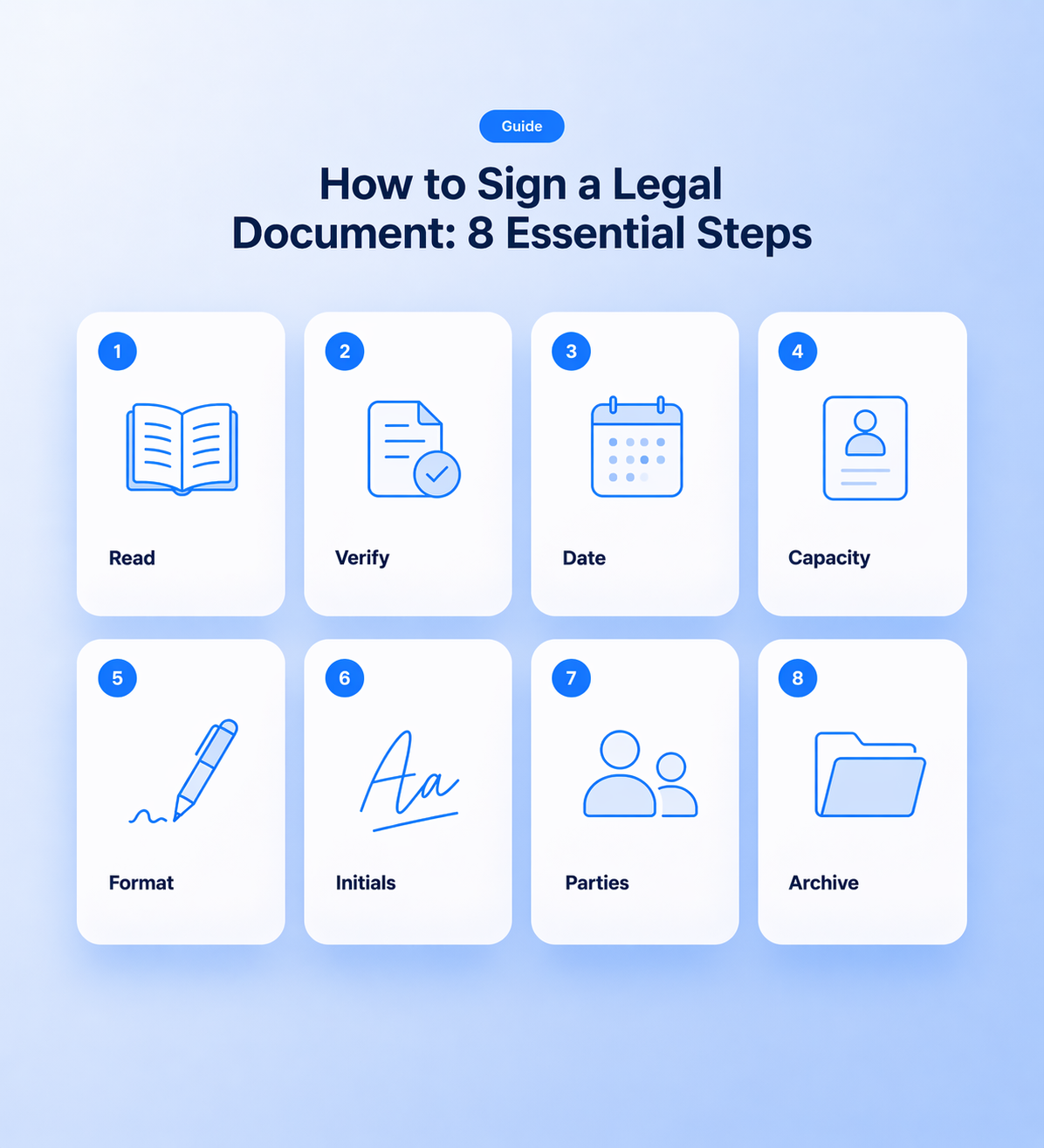
1. Read and Understand the Entire Document
Never sign a document you have not fully read. Courts generally assume that anyone who signs a document has reviewed and accepted its terms.
Take time to read every clause, including the fine print. If you encounter unfamiliar legal terms or confusing language, ask for clarification or consult a legal professional before signing.
Pay special attention to sections covering obligations, penalties, termination conditions, and dispute resolution. Signing without understanding could bind you to terms you never intended to accept.
2. Verify You Have the Correct Version
Documents often go through multiple revisions during negotiations. Before signing, confirm that the version in front of you reflects the final agreed-upon terms.
Compare key details like names, amounts, dates, and specific clauses against your notes or earlier drafts. Do not assume the document is correct simply because someone handed it to you.
A single changed word or missing paragraph could significantly alter your obligations. If anything looks different from what you agreed to, ask for an explanation before proceeding.
3. Check the Date and Effective Date
Every legal document should include a date. Dating your document helps identify it later and establishes when the agreement was made.
However, understand that the signing date and the effective date may differ. The effective date is when your obligations actually begin. For example, you might sign a lease in March, but the effective date could be April 1st when your tenancy starts.
Some contracts also allow backdating using phrases like "effective as of" to make terms apply retroactively. Always confirm both dates are correct before signing.
4. Sign in the Correct Capacity
How you sign matters as much as whether you sign. If you are signing as an individual, simply use your personal signature.
But if you are signing on behalf of a business, you must clearly indicate your representative capacity.
For example, if you are the owner of a company called "Sunrise Bakery LLC," your signature block should read: "Sunrise Bakery LLC, By: [Your Signature], [Your Name], Owner."
Failing to identify your role could make you personally liable for the business's obligations rather than the company itself.
5. Use the Proper Signature Format
Use blue or black ink when signing paper documents. Blue ink is often preferred because it makes it easier to distinguish an original document from a photocopy.
Avoid light colors like yellow or green, as scanners may not capture them clearly. Never sign important documents in pencil, as it can be erased or altered.
Your signature does not need to be in cursive, but it should be consistent with how you sign other legal documents. A distinct, recognizable signature helps verify your identity if the document is ever disputed.
6. Initial Any Amendments or Changes
If any handwritten changes are made to the document before signing, every party must initial next to each change. This confirms that all signers are aware of and agree to the modifications.
Write your initials in the margin beside the altered text, along with the date. Without initials, one party could later claim they were unaware of the changes.
For significant revisions, it is better to print a new version of the document rather than make multiple handwritten corrections, which can create confusion or appear unprofessional.
7. Ensure All Required Parties Sign
A contract is not complete until every required party has signed. Before considering your document finalized, verify that all signatories have added their signatures in the designated areas.
If parties cannot sign at the same time or location, many contracts include a "counterparts clause," which states that each party may sign separate copies that together form one complete agreement.
Also confirm that each person signing has the legal authority to do so. If a company representative signs without proper authorization, the contract may be challenged as unenforceable.
8. Keep an Original Signed Copy
After signing, ensure you receive an original signed copy for your records. If two parties are involved, two identical documents should be signed so each party retains an original.
Store your copy in a secure location, whether a physical filing cabinet, a safe, or a password-protected digital folder. You may need this document years later to prove the agreement existed or to resolve disputes.
For important contracts, consider keeping both a physical and a digital backup to protect against loss or damage.
Do You Need a Witness or Notary Public?
When Is a Witness Required?
A witness is someone who observes you signing a document and then adds their own signature to confirm they saw you sign. Witnesses are commonly required for wills, powers of attorney, property deeds, prenuptial agreements, and affidavits.
The purpose is to provide an independent person who can later testify that you signed voluntarily and were who you claimed to be. Even when not legally required, having a witness adds an extra layer of protection if your document is ever challenged.
When Is Notarization Required?
A notary public is a state-authorized official who verifies your identity, confirms you are signing voluntarily, and places their official seal on the document.
Notarization is typically required for real estate transactions, vehicle title transfers, certain financial documents, and court filings. Once notarized, a document becomes "self-authenticating," meaning its validity does not need to be proven separately in court.
Requirements vary by state, so check local laws to determine if your specific document needs notarization.
Rules for Witnesses and Notaries
Witnesses must generally be legal adults, mentally competent, and have no personal interest in the document. A beneficiary named in a will, for instance, should not serve as a witness to that will.
Notaries must follow strict state guidelines, including verifying identification and maintaining a record of transactions. Some documents require both a witness and a notary, and in those cases, they typically cannot be the same person.
If you lack access to a suitable witness, a notary can often serve that role when notarization is not separately required.
Can You Sign Legal Documents Electronically?
Are Electronic Signatures Legally Valid?
Yes, electronic signatures are legally valid in the United States. The federal ESIGN Act (2000) and the Uniform Electronic Transactions Act (UETA) give electronic signatures the same legal standing as traditional handwritten signatures. For an electronic signature to be enforceable, it must show clear intent to sign, all parties must consent to conduct business electronically, and the signature must be properly linked to the signer. Electronic signatures can include typing your name, clicking an "I Agree" button, drawing on a touchscreen, or using dedicated e-signature platforms.
When You Must Use a Wet Ink Signature
Despite widespread acceptance of electronic signatures, certain documents still require traditional pen-and-paper signatures. These typically include wills and trusts, adoption and family law documents, court orders and certain legal filings, real estate deeds in some states, notarized documents requiring in-person witnessing, and some government forms like immigration paperwork. Requirements vary by state and document type, so when in doubt, check local laws or consult a legal professional before signing electronically.
Common Questions About Signing Legal Documents
What Ink Color Should You Use?
Blue or black ink is recommended for signing legal documents. Blue ink is often preferred because it helps distinguish an original document from a photocopy. Avoid light colors like yellow or green.
Does Your Signature Have to Be in Cursive?
No, your signature does not need to be in cursive. You can print your name or use any consistent mark. What matters most is that the signature shows your intent and can be identified as yours.
Can You Sign on Behalf of Someone Else?
Yes, but only with proper legal authorization. You need a valid power of attorney or written consent from the person you are representing. Always clearly indicate you are signing in a representative capacity.
What Happens If You Sign the Wrong Document?
Signing the wrong document can create legal obligations you did not intend. Contact the other party immediately to void or correct the document. Acting quickly can help prevent enforcement of unintended terms.
Mistakes to Avoid When Signing Legal Documents
Signing legal documents carelessly can lead to disputes, financial loss, or unenforceable agreements. Here are common mistakes you should avoid.
Signing without reading — Never sign a document you have not fully read. Courts assume you understood and accepted every term once your signature is on the page.
Leaving blank spaces — Empty fields can be filled in after you sign, adding terms you never agreed to. Draw a line through any unused spaces before signing.
Using the wrong ink — Pencil signatures can be erased or altered. Light-colored inks may not scan properly. Always use blue or black ink.
Forgetting to date the document — An undated document can create confusion about when the agreement was made and when obligations begin.
Not keeping a copy — Always retain an original signed copy for your records. Without it, you may struggle to prove the agreement existed or what terms were included.
Signing in the wrong capacity — If representing a business, clearly indicate your role. Otherwise, you may become personally liable for the company's obligations.
When a Signed Legal Document May Not Be Valid
Signing a document does not always make it legally enforceable. There are situations where a signed agreement can still be challenged or rejected.
A document may not be valid if:
- One party was misled or important facts were hidden (fraud or misrepresentation)
- Someone was forced or pressured into signing (coercion)
- A signer did not have legal capacity (for example, due to age or mental condition)
- The agreement involves illegal terms or activities
- Key elements of a valid contract are missing
In these cases, a court may decide that the document is not enforceable, even if it was signed correctly.
That’s why it’s important not just to sign properly, but to understand what you are signing and the circumstances around it.
Final Thoughts
Signing a legal document is more than a formality—it is a commitment that carries real consequences. Taking a few extra minutes to read carefully, verify details, use proper signing practices, and keep copies can protect you from costly disputes later.
Whether you are signing a lease, business contract, or will, the steps outlined in this guide will help ensure your documents are valid, enforceable, and legally binding. When in doubt, consult a legal professional before signing.