How to Sign a Contract (Without Missing Anything Important)

Fast navigation
- Key Takeaways//
- Worried About Signing a Contract Wrong? //
- What Signing a Contract Actually Means//
- Step-by-Step: How to Sign a Contract Properly//
- How to Sign a Contract Online (Simple Walkthrough)//
- Are Electronic Signatures Legal and Safe?//
- Types of Signatures You Can Use//
- What to Check Before You Sign (Most People Skip This)//
- Common Mistakes That Cause Problems Later//
- What Happens After You Sign a Contract//
- Do I Need a Lawyer Before Signing?//
- How to Make Contract Signing Easier (and Faster)//
- Frequently Asked Questions
You’re holding a contract, pen in hand, and everything seems straightforward—but is it really?
A lot of people assume contracts are just formalities. In reality, they’re legally binding agreements that can affect your money, time, and responsibilities in ways you might not expect. Hidden clauses, unclear wording, or overlooked terms can turn a simple deal into a complicated problem later.
That’s why taking a few extra minutes to review before signing can save you from serious trouble.
In this guide, you’ll learn how to read a contract properly, spot red flags, and sign with confidence knowing exactly what you’re agreeing to.
Key Takeaways
- A signed contract is legally binding, so always understand what you’re agreeing to before putting your name on it.
- Focus on the key clauses first, like payment terms, deadlines, and exit conditions. These impact you the most.
- Electronic signatures are valid in most cases, but they still require proper intent, identity, and document integrity.
- Most contract problems come from simple mistakes like skipping the review, ignoring small clauses, or not verifying the signer.
- A clear process makes everything easier: review carefully, sign the right way, and always keep a copy for future reference.
Worried About Signing a Contract Wrong?
If you’ve ever looked at a contract and thought, “I don’t fully understand this, but I guess I’ll just sign it,” you’re not alone.
Most people struggle with legal terms, hidden clauses, and confusing wording. And the problem is, contracts aren’t forgiving. Once you sign, you’re usually locked into what’s written, not what you thought it meant.
A single mistake can lead to missed payments, unexpected fees, or long-term obligations you didn’t plan for. That’s why taking a few extra minutes before signing matters more than anything.
The good news? You don’t need to be a lawyer to do this right.
In the next sections, you’ll learn exactly what to check, how to sign safely, and how to avoid the common mistakes that cost people time and money.
What Signing a Contract Actually Means
At its core, signing a contract means one simple thing: you’re agreeing to a legally binding deal.
Once your signature is on it, you’re saying:
- I understand this
- I agree to this
- I will follow this
And this applies to more situations than you might think.
For example:
- Signing a freelance agreement with a client
- Accepting a job offer letter
- Clicking “I agree” on SaaS terms and conditions
- Entering a business partnership agreement
All of these are contracts.
What changes after you sign is important. You now have legal responsibilities, and the other party does too. If something goes wrong, the contract becomes the reference point for resolving it.
That’s why understanding it before signing isn’t optional. It’s essential.
Step-by-Step: How to Sign a Contract Properly
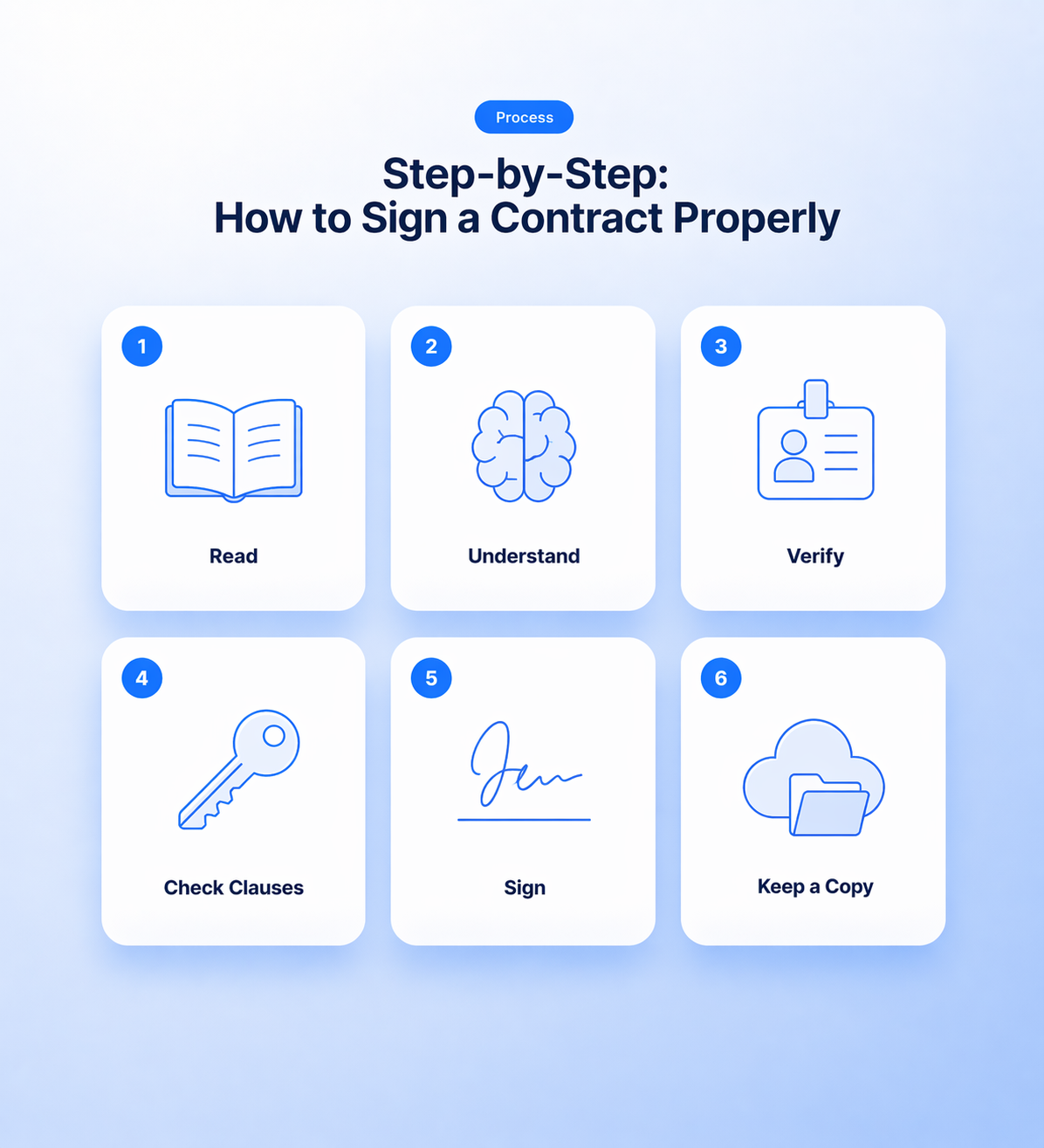
Step 1: Read It (Even If It’s Long)
Yes, it’s tempting to skim. Most people do.
But what actually matters isn’t every single word. Focus on:
- What you’re expected to do
- What you’ll get in return
- What happens if things go wrong
Even a quick but focused read is better than blindly signing.
Step 2: Understand What You’re Agreeing To
Don’t just read. Make sure it makes sense.
Pay attention to:
- Your rights (what you’re allowed to do)
- Your responsibilities (what you must do)
- Your risks (what could go wrong and who is liable)
If something feels unclear, pause. That confusion is usually a sign that something needs a closer look.
Step 3: Verify Who You’re Signing With
This step is often skipped, and it’s risky.
Make sure:
- The person or company is real
- They have the authority to sign
- Their details match what’s in the contract
Signing with the wrong or unclear party can make the entire agreement messy or even unenforceable.
Step 4: Check Key Clauses
This is where most problems hide.
Pay close attention to:
- Payment terms → How much, when, and how you get paid
- Deadlines → Deliverables, timelines, and penalties
- Exit terms → How you can leave the contract if needed
These three areas alone can save you from major headaches later.
Step 5: Sign It the Right Way
Now comes the actual signing.
You usually have two options:
- Paper signature → Print, sign, scan
- Digital signature → Click, type, or draw your signature online
Both are valid in most cases, as long as the process is done properly.
Choose the method that matches the situation and keeps a clear record of the agreement.
Step 6: Keep a Copy
Once it’s signed, don’t just move on.
Always keep a final copy of the contract. This is your proof if anything goes wrong later.
Store it somewhere safe and easy to access. You’ll need it if there’s ever a dispute, payment issue, or misunderstanding.
A signed contract only protects you if you can actually find it when it matters.
How to Sign a Contract Online (Simple Walkthrough)
If you’ve never done it before, online signing might feel confusing. In reality, it’s pretty straightforward.
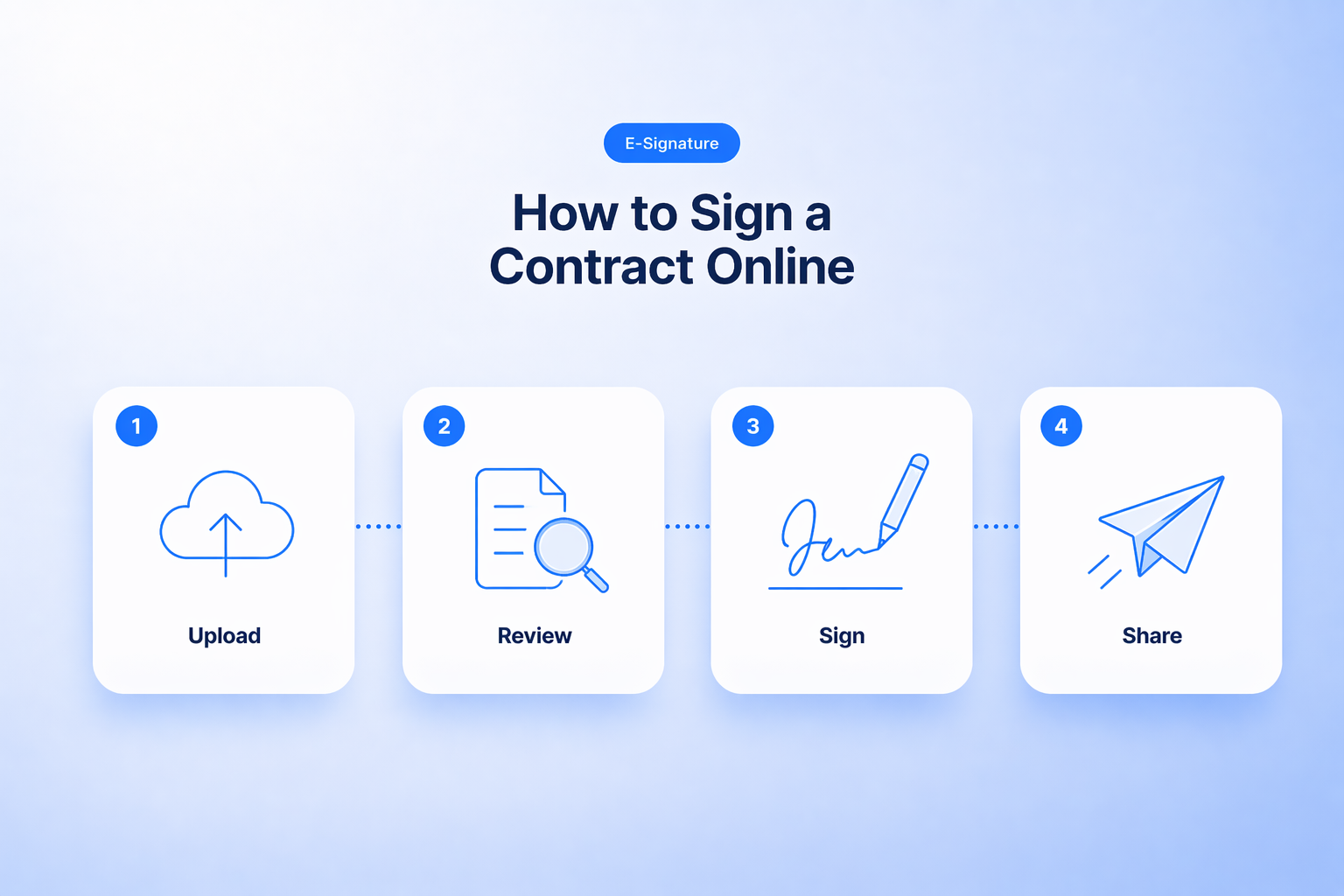
Here’s what it usually looks like:
- Upload → The contract is added to a platform
- Review → You go through the document carefully
- Sign → You type, draw, or click to sign
- Share → The signed copy is sent to all parties
That’s it. No printing, no scanning, no back-and-forth emails.
Where people usually get stuck is not the signing itself, but the steps around it:
- Skipping the review stage because it feels “too easy.”
- Not checking if the right person is signing
- Forgetting to download or store the final version
Online signing is fast, but the responsibility is still the same. You’re agreeing to a legal document, just in a simpler format.
Are Electronic Signatures Legal and Safe?
Short answer: yes, in most cases, electronic signatures are legally valid and secure.
Many countries recognize them as legally binding, as long as certain conditions are met.
What makes an electronic signature valid:
- There is a clear intent to sign
- The signer can be identified
- The document hasn’t been tampered with after signing
That’s why most platforms track things like timestamps, IP addresses, and document history.
In some situations, extra steps are needed:
- ID verification for high-value agreements
- Witnesses or notarization for specific legal documents
- Compliance with local laws if parties are in different regions
So while most everyday contracts can be signed online without issues, more sensitive agreements may require an extra layer of verification.
Types of Signatures You Can Use
Handwritten Signature (Paper)
This is the traditional method. You print the document, sign it with a pen, and scan or share it.
It works well when:
- Physical copies are required
- The process involves witnesses or notarization
- You’re dealing with formal or government-related documents
Basic Electronic Signature (Typed or Clicked)
This is the most common option today.
You simply:
- Type your name
- Draw your signature
- Or click a “Sign” button
It’s quick and convenient, and works for most everyday agreements like:
- Freelance contracts
- Service agreements
- Online terms and approvals
Verified Electronic Signature (Secure & Trackable)
This adds an extra layer of security.
It includes:
- Identity verification
- Audit trails (who signed, when, from where)
- Protection against document changes
This type is best when:
- The contract involves a higher risk or value
- You need strong proof in case of disputes
- Multiple stakeholders are involved
What to Check Before You Sign (Most People Skip This)
This is where most people rush. And this is exactly where problems start.
Before you sign anything, take a minute and check these key areas:
- Are you authorized to sign? Make sure you actually have the legal authority to sign. If you’re signing on behalf of a company, your role needs to allow it. Otherwise, the contract may not hold, and you could be personally responsible.
- Payment terms and penalties Look closely at how much you’re getting paid, when, and under what conditions. Also check for late fees, penalties, or hidden charges. This is where money issues usually come from.
- Deadlines and renewal traps Watch for strict deadlines, auto-renewals, or long-term commitments. Some contracts quietly renew if you don’t cancel in time.
- Exit conditions Ask yourself: How do I get out of this if needed? A good contract clearly explains termination rules, notice periods, and any penalties for leaving early.
- Legal jurisdiction This defines which country or state laws apply if there’s a dispute. It matters more than people think, especially if you’re dealing with someone in another location.
Missing even one of these can turn a simple agreement into a long-term problem.
Common Mistakes That Cause Problems Later
Most contract issues don’t come from complex legal loopholes. They come from simple mistakes people make in a hurry.
Here are the ones to avoid:
- Signing without understanding- If you don’t fully understand what you’re agreeing to, you’re taking a risk. Even a small clause can change everything.
- Trusting verbal promises- If it’s not written in the contract, it usually doesn’t count. Always rely on what’s documented, not what was said.
- Ignoring small clauses- The “fine print” often includes fees, restrictions, or conditions that can affect you later. Don’t skip it.
- Not verifying the signer- Make sure the other person has the authority to sign. Otherwise, the agreement might not be enforceable.
- Losing the final copy- A contract only protects you if you can prove it exists. Always keep a signed, final version stored safely.
These mistakes are easy to avoid once you know what to look for. And avoiding them can save you from serious issues down the line.
What Happens After You Sign a Contract
Once you sign, things change immediately.
- When it becomes enforceable- In most cases, a contract becomes legally enforceable as soon as all parties sign it. That means the terms are no longer optional. They’re binding.
- What both sides are now responsible for
Each side must follow what’s written. That includes:
- Deliverables (what needs to be done)
- Payments (how and when money moves)
- Timelines (deadlines and milestones)
- If one side doesn’t follow through, the other side has the right to take action based on the contract.
- What to do if something goes wrong
Don’t panic. Start with the contract itself. Check:
- The terms you agreed to
- The exit or dispute clause
- Any penalties or remedies listed
- Most contracts already explain what should happen in a dispute. Use that as your first step before escalating things further.
Do I Need a Lawyer Before Signing?
A lot of people pause right before signing and think, “Should I have someone check this?” That hesitation is valid.
If you don’t fully understand the contract, signing it blindly can create problems that show up later, not immediately.
- When it’s worth it
You should involve a lawyer if:
- The deal involves a large amount of money
- You’re committing to something long-term
- The terms feel confusing or heavily worded
- There’s clear legal risk or liability involved
- Even a quick review can point out things you might miss.
- When you can handle it yourself
You can usually proceed on your own if:
- It’s a simple, standard agreement
- The terms are clear and easy to understand
- The risk is relatively low
- In these cases, careful reading and checking key clauses is often enough.
- Cost expectations (simple explanation)
Costs depend on complexity, but generally:
- A basic review may cost a fixed fee
- More detailed contracts cost more based on the time spent
- It’s not always necessary, but when the stakes are high, it can save you from bigger issues later.
How to Make Contract Signing Easier (and Faster)
Most delays don’t come from the signing itself. They come from messy processes around it.
Here’s how to make things smoother:
- Organizing contracts Keep all documents in one place. Use clear file names and versions, so you’re not guessing which one is final. This avoids confusion and mistakes.
- Reducing back-and-forth
A lot of time is lost in emails and revisions. Try to:
- Finalize terms before sending
- Avoid multiple versions floating around
- Keep communication clear and direct
- Using structured workflows
A simple process makes everything faster:
- Send → Review → Sign → Store
- When this flow is consistent, you avoid delays, missed steps, and unnecessary follow-ups.
The easier your process is, the less likely you are to make mistakes while signing.
Frequently Asked Questions
Is a digitally signed contract legally binding?
Yes, digitally signed contracts are legally binding in most cases. As long as there is clear intent to sign, both parties can be identified, and the document hasn’t been altered, the signature is valid. Many countries recognize electronic signatures the same way as handwritten ones.
Can I cancel a contract after signing it?
It depends on the contract terms. Some agreements include a cancellation or exit clause, which allows you to leave under certain conditions. If there’s no such clause, canceling may involve penalties or legal consequences. Always check the exit terms before signing.
Do both parties need to sign the same way?
No, both parties don’t always need to sign the same way. One party can use a handwritten signature, while the other uses a digital signature, as long as both agree and the method is legally acceptable. What matters is that both signatures are valid and clearly linked to the agreement.
Is typing your name a valid signature?
Yes, in many cases, typing your name can count as a valid electronic signature. It works when there is a clear intent to sign and the system records proof, such as timestamps or user identity. However, for higher-risk agreements, more secure methods may be required.
What happens if someone signs without authority?
If someone signs without proper authority, the contract may be invalid or unenforceable. In some cases, the person who signed could be personally responsible for the agreement. That’s why it’s important to verify that the signer has the right to act on behalf of the organization.